Resynchronize subtitles
Contents
Resynchronize a single subtitle
If you want to resynchronize only one subtitle (or subtitles one by one), there are several options:
- In the detailed timeline (the bottom one), you can drag the start, end, or entire subtitle to the desired position.
- In the "Subtitle edition" palette, you will find "Start" and "End" fields where you can enter the subtitle's start and end timings.
-
You can also place subtitle beginning (
 ) and subtitle end (
 ) markers, then use the edition palette buttons to move the
subtitle's start (
) markers, then use the edition palette buttons to move the
subtitle's start ( and
and  ) or end (
 and
and  ) to them. You can do the same without markers, using the
playback cursor instead; in that case, use the following buttons:
) to them. You can do the same without markers, using the
playback cursor instead; in that case, use the following buttons:  and
and  .
.
The buttons
 and
and  let you jump in the video to the displayed timing.
Types of desynchronization
Conversely, if you want to resynchronize several subtitles (or even the entire file) in one step, note that there are several types of desynchronization:
- Constant shift
- In this case, all subtitles are shifted by the same value. Current timing A and correct timing C are linked by the formula C = A + K, where K is a constant. This happens, for example, when parts of the video are added or removed: the following subtitles are then shifted by the duration of the added or removed section.
- Affine shift
- In this case, subtitles become increasingly or decreasingly shifted as the video progresses. The shift increases or decreases at a constant rate. Current timing A and correct timing C are linked by the formula C = K1 * A + K2, where K1 and K2 are constants. This happens in particular when subtitles are based on frame numbers rather than on time: changing the frame rate will desynchronize the subtitles.
- Non-linear shift
- Here, the subtitle shift does not follow either of the formulas above. Subs Factory cannot handle this case; you will need to treat it section by section (or even subtitle by subtitle), as if each section had a constant or affine shift. Fortunately, this case is fairly rare.
Choosing reference subtitles
Choose two subtitles whose placement in the video you know, and that are part of the subtitles to
resynchronize. Resynchronization will be more accurate if you choose two subtitles as far apart as possible.
Take, for example, the first and last subtitles to resynchronize. Note their numbers. Then place one marker for
each of them: either an "In" marker where the
subtitle should begin, or an "Out" marker where it
should end.
Resynchronization window
Go to the "Actions" palette of the subtitle file concerned. Click the "Resynchronize" button. The following window should appear:
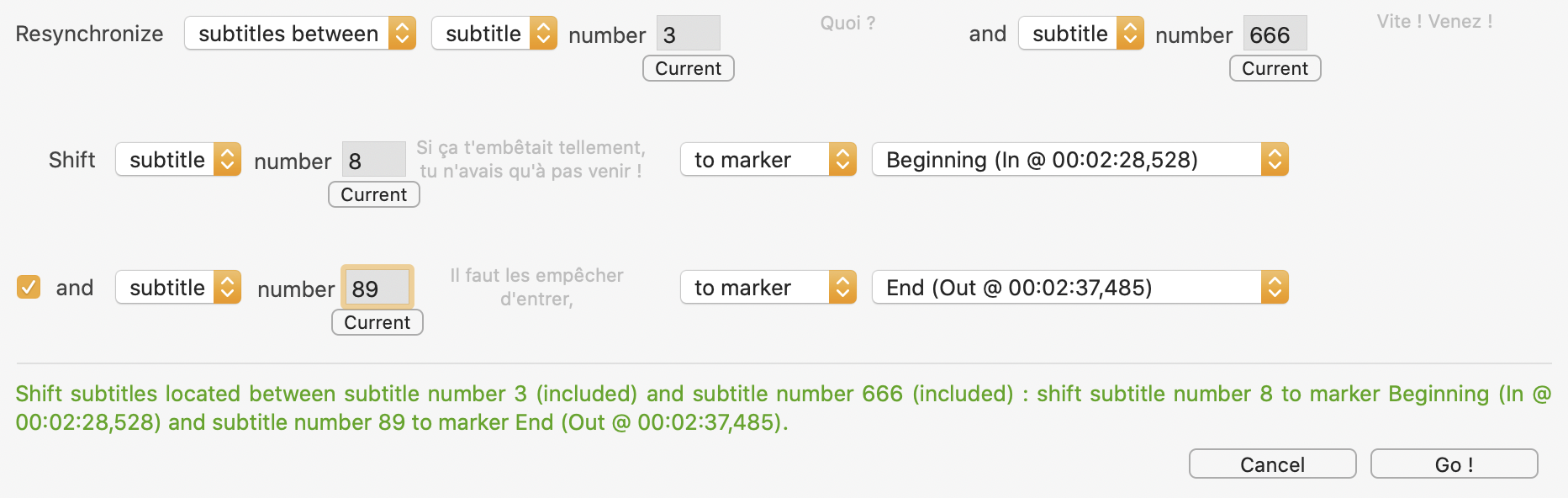
The window forms a sentence describing how the subtitles will be resynchronized. Boxes embedded in this sentence allow you to configure the resynchronization.
Each box is a selector that lets you choose an element (subtitle, marker, timing, duration). Buttons above let you choose the selection mode:
 by a marker: select a marker from the drop-down list,
 by a subtitle: enter its number, or click the
  button to select the subtitle currently displayed; a preview of the subtitle text appears beside it,
 by a timing: manually enter a timing in the current format, or click the button to select the current timing,
 duration selection: manually enter the duration. Note that this works differently: for example, the current subtitle will be shifted by the indicated duration instead of being moved to the indicated position.
The first line defines the range of subtitles to resynchronize: indicate its beginning and end (or its beginning and duration).
When the window opens, all subtitles are selected for resynchronization by default.
The second line indicates the first reference point: where an element whose correct position you know is currently located, and where it should be after correction.
If you want a second reference point, turn on the switch on the third line and indicate it in the same way. One point is enough when all subtitles are shifted by the same duration; a second point is useful when the gap varies over the course of the video.
If you shift a subtitle towards a beginning marker (), the beginning of the subtitle will be moved to that position. If you shift it towards an end marker (), the end of the subtitle will be moved to that position.
Below, you will find a preview of the shift that will be applied, allowing you to check that the result matches your expectations. The top timeline shows the subtitles before correction, and the bottom one afterwards. Brackets indicate the range of subtitles concerned, and arrows show how the reference point(s) will move.
Press the « Go ! » button to apply the resynchronization.